


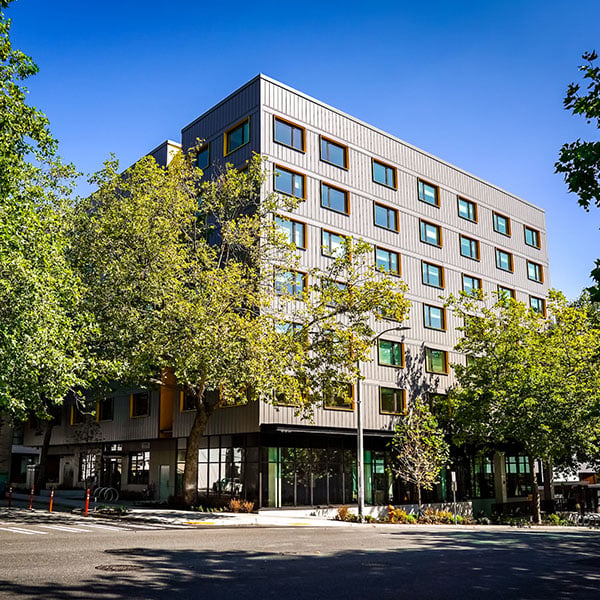
Nearly 1,500 people who have experienced homelessness live in permanent supportive housing provided by Plymouth Housing in Seattle and on the Eastside. The organization operates 18 apartment buildings and reports that 95% of its residents remain safely and stably housed after moving in.
The Hao Dang Real Estate Team recently learned more about this work at Plymouth Housing's Key to Hope event in Seattle. More than 1,100 people attended the September 2026 event, raising more than $1.5 million for the organization's housing and services.
Our team spends its working days helping people buy and sell residential real estate. Plymouth serves people who have experienced chronic homelessness. Those are very different areas of Seattle's housing system, but understanding Plymouth's work gave us a reason to learn more about a form of housing we don't encounter in our everyday business: permanent supportive housing.
What Is Permanent Supportive Housing?
Permanent supportive housing combines long-term affordable housing with services for people who have experienced chronic homelessness and may also be managing health, behavioral health or other significant challenges.
It is not an emergency shelter or temporary housing program.
Residents have their own apartments and leases. Seattle's Office of Housing explains that residents have the same tenant protections as other renters, while supportive services are available to help them remain housed and live as independently as possible.
Those services can vary according to the needs of individual residents. They may include connections to health and behavioral health care, benefits, employment resources and other assistance.
The distinction between temporary shelter and permanent housing is central to the model. A resident does not have to leave after a predetermined period or complete a program before being considered ready for permanent housing.
What Happens After People Move Into Permanent Housing?
King County's Health Through Housing program provides another local example of permanent supportive housing and publishes data about resident outcomes.
In its 2025 results, King County reported that 93% of permanent supportive housing residents remained housed or moved into another form of permanent housing.
The county also compared residents' use of several public systems before and after they entered housing. Hospital admissions, emergency department visits and jail bookings decreased after residents were housed.
Those findings don't mean housing resolves every medical, financial or personal problem a resident may face. They do show measurable changes after people who had experienced chronic homelessness obtained permanent housing.
That evidence also helps explain why supportive housing combines an apartment with access to services rather than treating the two as separate needs.
Plymouth Housing Has Expanded From Seattle to the Eastside
Plymouth Housing began serving people experiencing homelessness in Seattle in 1980. Its properties are now located in both Seattle and the Eastside.
One of its newest communities is in Kirkland.
Sheila Stanton Place opened in July 2026 through a partnership among Plymouth Housing, King County and the City of Kirkland. The property provides permanent supportive housing for people who have experienced chronic homelessness and includes deeply affordable apartments, voluntary supportive services and 24-hour staffing.
The Kirkland location places permanent supportive housing within an Eastside housing market that is more commonly discussed in terms of home prices, new development, inventory and homeownership.
Both exist in the same community.
For our team, that is particularly relevant. We regularly work with buyers and sellers in Kirkland, Bellevue, Redmond and other Eastside communities. Sheila Stanton Place introduced us to housing work taking place within the same geographic area but serving residents with entirely different needs.
Seattle's Housing System Serves People in Very Different Circumstances
A person buying a home and a person moving out of chronic homelessness are not facing comparable housing decisions.
For the buyers we represent, the questions may involve financing, commute, property type, condition, location and long-term plans. Sellers may be considering equity, preparation, market value, timing and where they will live next.
Permanent supportive housing addresses a different problem: how to provide long-term housing to people who have been unable to remain consistently housed.
Keeping those distinctions clear is important.
It would be easy for a real estate company to use homelessness as a backdrop for a generalized message about how “everyone deserves a home.” That doesn't explain the problem, the work being done or the people doing it.
Learning what permanent supportive housing actually is gives us a better understanding of one specific response to chronic homelessness in King County.
What We Heard at Key to Hope
Author Cheryl Strayed was the keynote speaker at the 2026 Key to Hope event. Her discussion included periods of housing insecurity in her own life and the experience of having to begin again. Plymouth residents and staff also spoke about their experiences with homelessness and permanent supportive housing.
The resident stories put the housing model into human terms, while the data provides another way to evaluate it.
Plymouth reports that approximately 95% of its residents remain safely and stably housed. King County's separate Health Through Housing program reports similarly high housing-retention results.
Those numbers tell us something specific about permanent supportive housing: most residents in these local programs are remaining in permanent housing after experiencing homelessness.
That was one of the most useful things our team took away from the event.
Understanding More of the Community Where We Work
The Hao Dang Real Estate Team's expertise is residential real estate. We help people buy and sell homes throughout Seattle, the Eastside and surrounding King and Snohomish County communities.
Attending Key to Hope didn't make us experts in homelessness or supportive housing.
It introduced us to people who are.
Plymouth Housing has spent decades developing and operating permanent supportive housing in Seattle. King County and local cities are also investing in supportive housing, including the new Kirkland community that opened this year.
Understanding that work gives us a more complete picture of housing in the communities where we conduct our business.
It also gives us a concrete way to act on the sentiment behind the original social post. Rather than simply saying that a home can provide safety, stability or an opportunity to begin again, we can look at the organizations doing that work and the outcomes they are reporting.
For anyone interested in learning more, Plymouth Housing provides information about its permanent supportive housing, resident services, volunteer opportunities and ways to support the organization.
Check out this article next